January 31, 2026

Where Are The Wealthy Putting Their Money?

Introduction


"It was never my thinking that made the big money for me. It was always my sitting. Got that? My sitting tight!" - Jesse Livermore


“The big money is not in the buying and the selling, but in the waiting” - Charlie Munger


It’s easy to feel unconfident as an investor today. We are currently operating in a market of ‘brittle optimism’, where major indices flirt with all-time highs while headlines warn of trade wars, a potential AI bubble burst, and the destabilization of institutions.

For many people, the natural instinct in the face of volatility and future uncertainty is to protect what they have by taking defensive positions, hedging, or selling altogether until the future feels rosy again.


But that doesn’t appear to be what the wealthy are doing. In this edition of the Bird’s Eye View, we consider the data from three wealth reports (
Tiger 21, Knight Frank, and Capgemini) to see how different cohorts of the wealthy are positioning their portfolios, and how their portfolio construction is changing in response to uncertainty.

Asset Allocations by Investor Profile


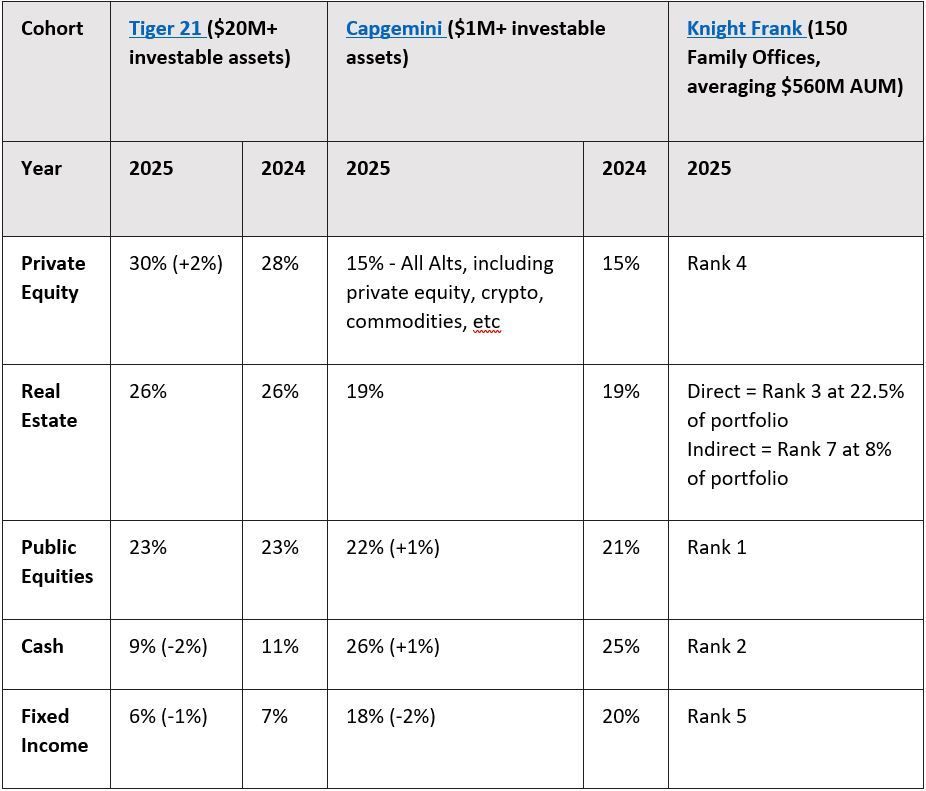
The table below represents the most recent reported weightings and rankings across the three major cohorts. Note that while Tiger 21 and Capgemini provide percentage-based portfolios, the Knight Frank data reflects rankings by weight within institutional family offices.

Map of Canada showing areas covered by historic treaties, color-coded by treaty type.

Source: Table created by Hawkeye Wealth, based on Tiger 21,Knight Frank, andCapgemini data

Understanding the Cohorts

To find the signal in this data, we must understand the differences between these groups of wealthy. The portfolio allocation differences between the cohorts sampled in these reports are a reflection of different approaches that people with different levels of wealth tend to display on average.


Tiger 21 Entrepreneurs: Active Capital


Tiger 21 members must have $20M+ in investible assets to join. These are mostly former entrepreneurs with high risk tolerance who went from running their businesses to actively managing their newfound wealth after a liquidity event.

The Tiger 21 data is revealing because of how it is collected. Instead of the typical anonymous survey, the data comes from the “portfolio defense” presentation that members make to their peers each year, defending their investment decisions and the reasoning behind each position.


We suspect that the peer-to-peer justification, reflected in their much lower levels of cash (9%) compared to other HNWIs (High Net Worth Investors). While they hold similar levels of public equities and real estate as other HNWIs, they have a larger 30% allocation toward private equity, demonstrating a preference for investments where they have specialized knowledge, influence or control.


The Average High Net Worth Individual: A Preservationist


The vast majority of respondents in the Capgemini survey are people with investable assets in the $1M to $5M range (89.8% of respondents). These are the "Millionaires Next Door" who built their wealth through traditional careers or small businesses.

This group has enough money to live comfortably through retirement, provided they avoid major missteps. That need for safety is reflected in their heavy 26% allocation to cash and 18% to fixed income.  They hold significantly less in real estate and alternative investments.

The cost of this ‘safety’ clearly manifests in stronger markets.  From 2023-2024, these investors increased their wealth by 2.6%.  Meanwhile, UHNWIs (Ultra High Net Worth Individuals - $30M+), who held much lower levels of cash and fixed income, grew their total wealth by 6.3% over the same period.


Family Offices: Balancing Growth and Preserving Generational Wealth

The Knight Frank data samples institutional family offices with an average of $560M of assets under management.

Between direct ownership (22.5%) and indirect ownership (8%), family offices hold a higher proportion of real estate compared to other HNWI portfolios.  These offices aren’t always trying to hit home runs with their real estate because it serves so many useful functions for family offices, from capital appreciation and income generation, to wealth preservation and geographic/sector diversification.


The Knight Frank data indicates that on average, family offices are targeting an annual unleveraged return of 13.8% on their real estate holdings.  Their allocations strike a middle ground between the high cash and fixed income positions of the HNWIs sampled by Capgemini, and the high private equity allocations of the UHNWIs sampled by Tiger 21.


The Commonality: Subtle Shifts


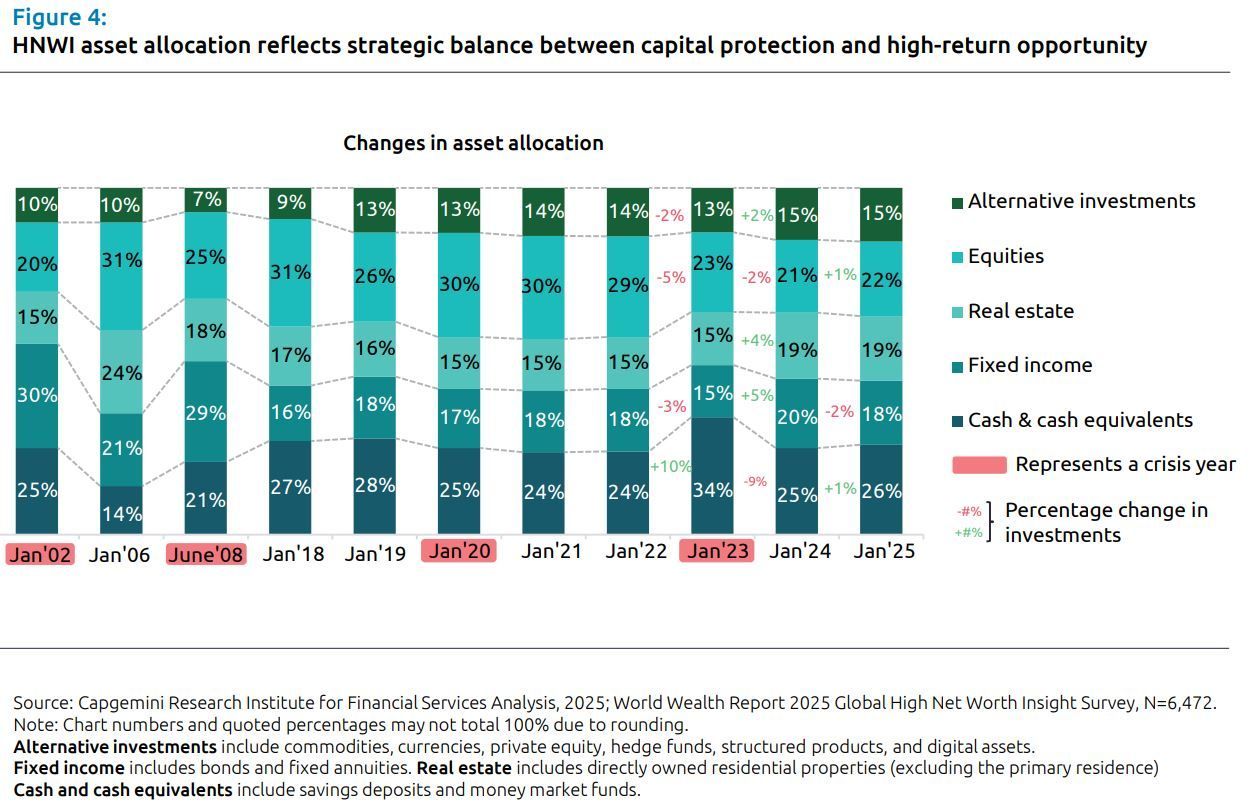
While each cohort has different levels of wealth and goals, the overall allocations tend not to change much from year to year.  Even through periods of crisis, these investors don’t make radical changes.  The wealthy as a whole tend to avoid impulsivity and practice patience.

The Chart below shows asset allocation percentages since the turn of the millennium:

Conclusion


If world affairs or headlines have you feeling anxious, it can be helpful to step back and review your portfolio in a broader context. Are you feeling uneasy because your exposure no longer aligns with your long-term goals, or simply because short-term noise is dominating the conversation?


The data suggests that many wealthy investors are not attempting to outmaneuver markets through dramatic shifts. Instead, they focus on constructing portfolios that support their long-term goals and will be resilient across cycles, allowing them to remain patient through uncertainty.

Author

Hawkeye Wealth Ltd.

Date

January 31, 2026

Share

By Hawkeye Wealth Ltd. December 20, 2025
“The provincial government has provided local government with only two options to build infrastructure: development cost charges and property taxes. And I will always be on the side of property taxpayers, and we will look for developers and ‘growth to pay for growth’ as a principle.” - BC Mayor, Oct 9, 2024
By Hawkeye Wealth Ltd. November 1, 2025
“To a landowner, there is nothing more important than security of title. Once you have fee-simple title in B.C., it has to mean that land is your land. And that is very fundamental to our province – and in fact, to the country.” - Niki Sharma, BC Attorney Genera l
By Hawkeye Wealth Ltd. October 4, 2025
Introduction Canadian farmland hasn’t posted a single annual decline in value since 1992 . Take a second to soak that up. More than thirty years, multiple recessions, inflation spikes, a housing crash and a tech- bubble. Through it all, farmland kept climbing. In a world where many asset classes appear vulnerable to technological disruption or shifting consumer preferences, the core value in farmland is tied to a necessity that will always remain constant. Food. In this edition of the Bird’s Eye View , we discuss the case for investing in Canadian farmland and share the most compelling points and potential risks from our due diligence on this asset class.  The Investment Case for Canadian Farmland In our view, farmland has six main features that make farmland investment attractive: 1. Consistent Performance and Low Volatility - A 30+ year track-record of positive annual returns is astounding, even more so when you consider that the average annual increase over that period has been 8.1%. Past performance doesn’t guarantee future returns, but there is merit to the fact that farmland has been remarkably consistent through periods of high market volatility. When considering that the figures above don’t account for any profit from the land, farmland has done an impressive job of delivering returns comparable to U.S. equities, but with a volatility profile that more closely resembles bonds. 2. Natural Scarcity - Most cities are established near fresh water and fertile soil. Thus as populations grow and cities expand, that development inherently reduces the base of potential farmland. While most provinces have some level of agricultural land protection program in place, the fact remains that there is a finite amount of farmable land, and each year there is less of it. 3. Diversification and Inflation Hedge - Farmland has a long track record of holding its value when inflation eats away at other assets. Rising food prices translate directly into stronger farm revenues, which in turn support rental income and land appreciation. Additionally, over the last 50 years, farms have averaged an increase in productivity of ~1.5% per year by adopting new technology and processes (machinery, irrigation, nutrient management), which serves as a natural inflation hedge. Unlike equities or bonds, farmland’s performance has shown little correlation with public markets , giving it genuine diversification benefits. 4. Investor-Tenant Alignment - For anyone feeling exhausted with the rhetoric about ‘greedy developers’, it may come as welcome news that investors and landlords aren’t automatically the bad guy in the farmland space. Research shows that farmers are able to drive higher levels of profitability per acre when renting compared to when purchasing farmland , and that trend is accelerating. While renting doesn’t necessarily outperform ownership over the long-run when accounting for land appreciation benefits, it does improve cashflow. Since farming is capital intensive, renting land allows farmers to allocate funds that would have otherwise gone to land, toward equipment and operations that improve yield and profitability. Since farmers’ profitability depends on sustaining yields, they are naturally incentivized to care for the soil and manage the land well, which not only supports their own returns but helps preserve and even enhance the underlying land value. As a result, the ‘renter’s mentality’ sometimes seen in other real estate sectors is far less common in farming. 5. Comparative Affordability - In housing, the current challenge is that people can’t afford to pay what developers can feasibly build. In comparison, while farms are comparatively less affordable than they were 5 years ago, the gap is far less dramatic than it has been in housing. Farm values and rents have rapidly increased, but the revenue generated by those farms has also substantially increased , which has slowed the loss of affordability. While current affordability levels are still a concern in the space, farmers can still operate profitably at current price levels and as shown on the chart below from Farm Credit Canada , we are nowhere near the peaks of unaffordability that farmers experienced during the 1980’s: