
Signals of a Market Bottom - A Deep Dive
“Rule No. 1: Most things will prove to be cyclical. Rule No. 2: Some of the greatest opportunities for gain and loss come when people forget Rule No. 1.”
— Howard Marks, Oaktree Capital
Introduction
In the past, we’ve written about the market cycle generally, but today we will take a more focused approach as we walk through 40 years of data to better understand the typical conditions and signals associated with market bottoms.
There are 4 different statistics that when combined, provide exceptional insight into market health and likely price trajectory for any given housing type: unabsorbed inventory, completions, inventory under construction and average construction times.
In this edition of the bird’s eye view, we take a rigorous approach to walking you through the CMHCs data on each of these statistics, discuss how they are used to understand and forecast market bottoms, and share rough estimates for how far off a market bottom each housing type is.
Unabsorbed inventory
Unabsorbed inventory refers to residential units that have reached physical completion but that have yet to be purchased or rented. It’s a critical variable for assessing market health and for determining position within the market cycle because it has very little lag effect. If unabsorbed inventory is on the rise, it’s because people can’t or aren’t willing to pay at current price levels. Similarly, if it’s falling, it’s because demand is outpacing supply in real time.
While there are lots of variables in real estate that have connection to prices, there are very few where that relationship is so immediately obvious. Market bottoms tend to coincide with periods of high unabsorbed inventory, and market tops are associated with low unabsorbed inventory.
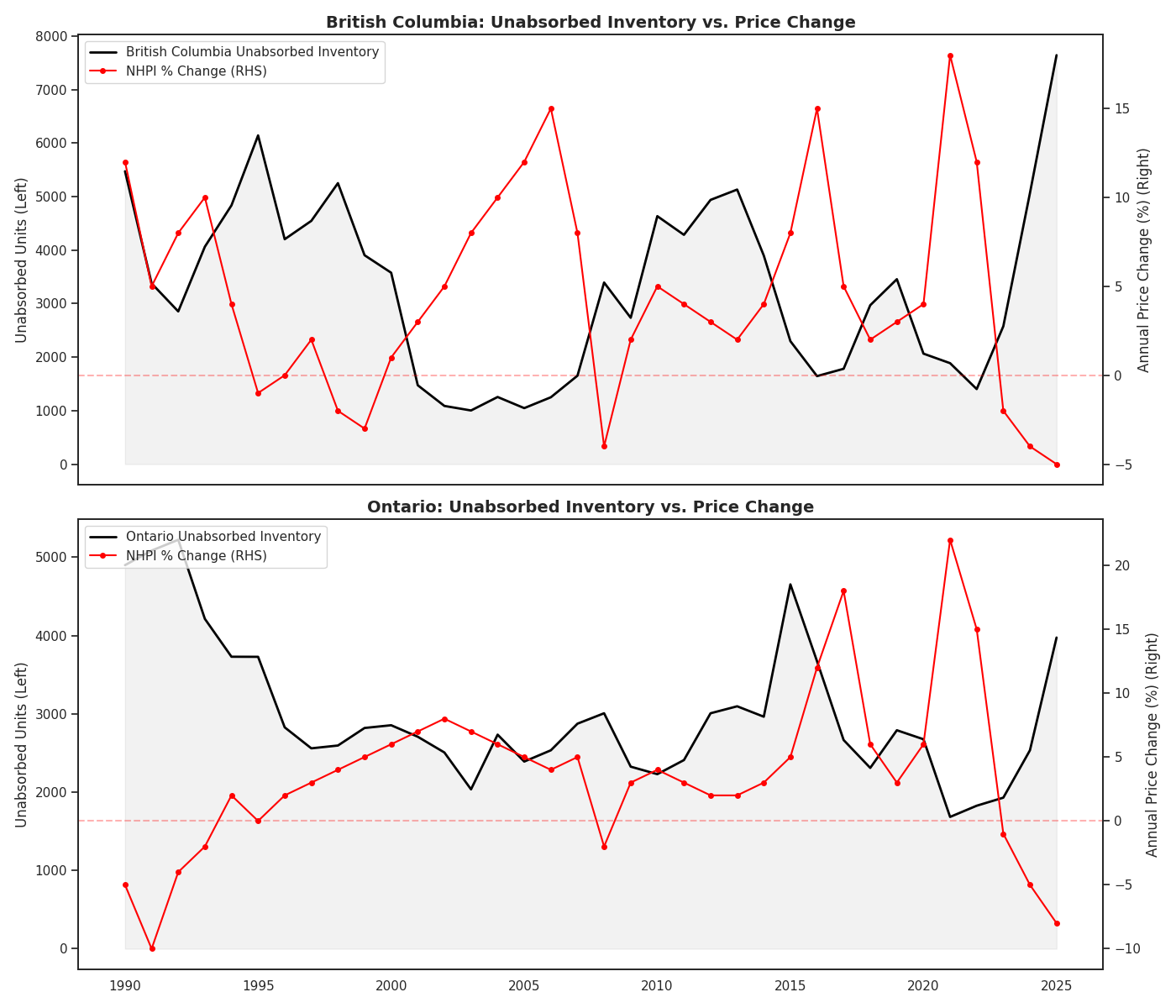
On the charts below, note the periods of high and low unabsorbed inventory represented by the black line, and compare it to the annual percentage change in the New Housing Price Index represented by the red line. The top chart is BC and Ontario is on the bottom:
Source: Data from CMHC Housing Market Information Portal, Statistics Canada, Table 18-10-0205-01
*Cautionary Note: As always, data is only a useful predictor when it is reliable, and while we believe the CMHC data generally corresponds with conditions on the ground in terms of direction, we suspect there is something inconsistent happening with the absolute numbers. It genuinely surprises us that BC is reported to have almost half of all unabsorbed units in Canada and nearly twice as many unabsorbed units as Ontario. The CMHC has formally acknowledged it “is conducting a methodology review of the unabsorbed inventory data series in the Ontario context, and advises that this data be used with caution.”
There may be issues with this data and we don’t know which way the data might be skewed, but we do believe that unabsorbed inventory in both markets is at or near its all time highs. As is typical of this inverse relationship, prices have been falling to match.
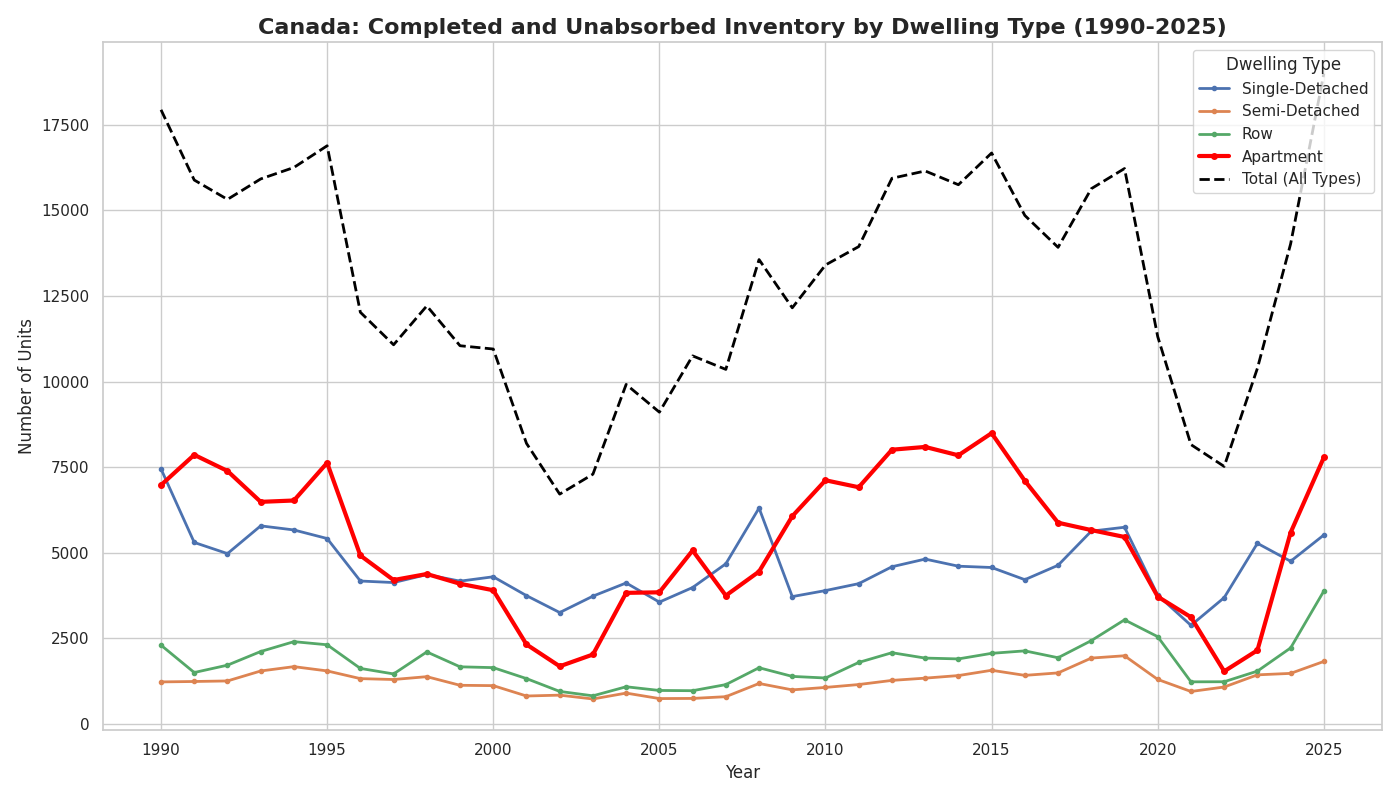
But there is a wrinkle to this logic. Not all asset classes are going through the same level of absorption crisis. Consider the data below across Canada as a whole:
Source: Data from CMHC Housing Market Information Portal
Since 2022, the delivery of new completions across all housing types has consistently outpaced market absorption, signaling a growing disconnect between pricing and current buyer demand. Even as prices have fallen, unabsorbed inventories have continued to climb, which puts further downward pressure on prices.
Knowing what is happening has some use, but the real value comes from using this data to get a sense for what may happen over the next 1-2 years. To do that, we need to understand how many completions there have been and how many there are likely to be based on average construction times as inventory under construction is completed.
Completions
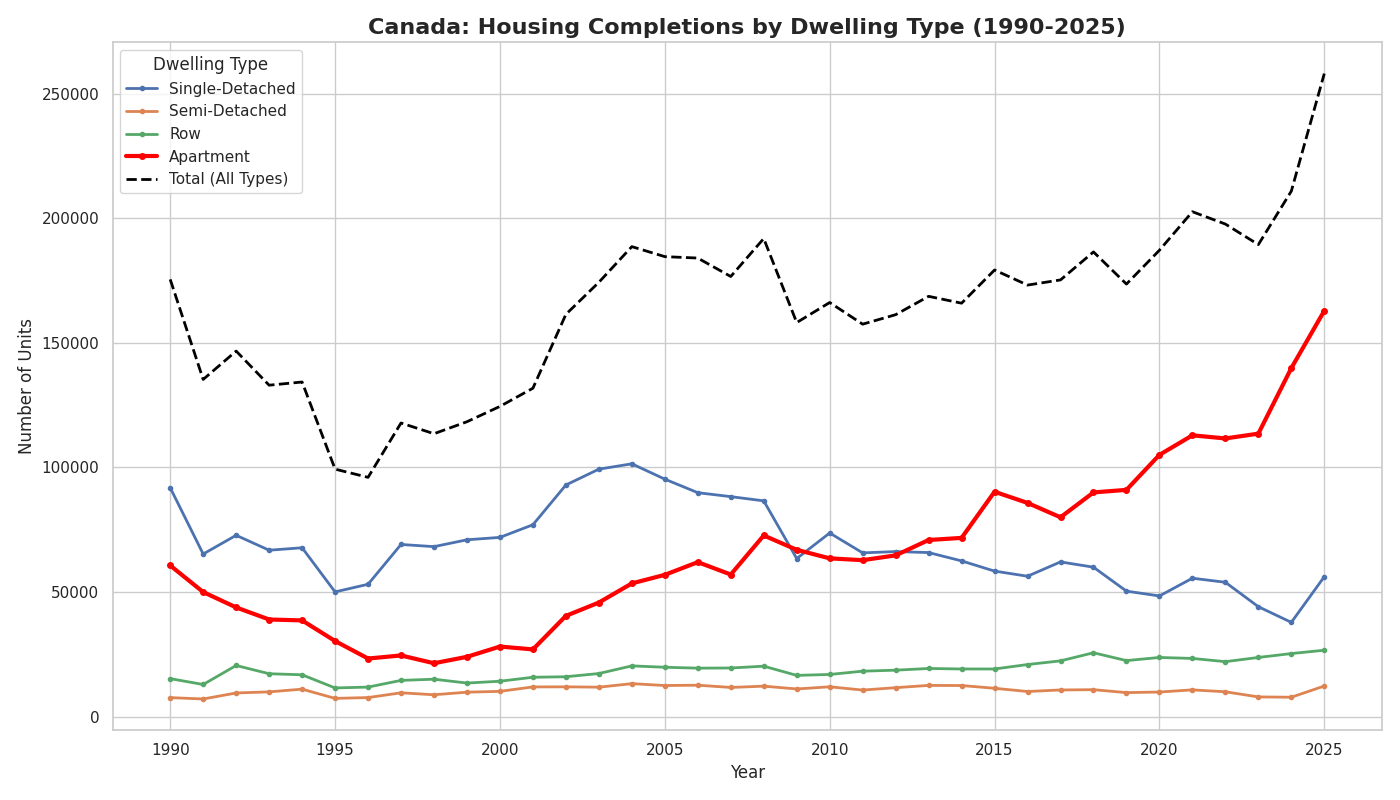
When unabsorbed inventory is considered alongside completions, you get a sense for the number of new units that the market can absorb:
Source:
Data from CMHC Housing Market Information Portal
Looking at each asset class, the absorption picture becomes more clear.
Apartments - Historically high levels of apartment completions in 2023-2025 pushed the unabsorbed inventory higher, but the class has actually performed comparatively well. Apartments represent 63.2% of all completions in 2025, but only 41% of the unabsorbed units.
Row housing - Completions were well above historical averages, but the market has hit a saturation point. Row housing represents 10.3% of all completions, but 20.4% of the total unabsorbed inventory. These units are having a hard time finding buyers at current price levels.
Single detached
- Completions have been slightly below historical averages over the last 5 years, unabsorbed inventory has climbed, meaning demand for single detached has been tepid. Single-detached homes account for 21.8% of total completions, but 29% of unabsorbed inventory.
Semi-detached
- This type only represents 4.8% of total completions, but makes up 9.6% of unabsorbed inventory.
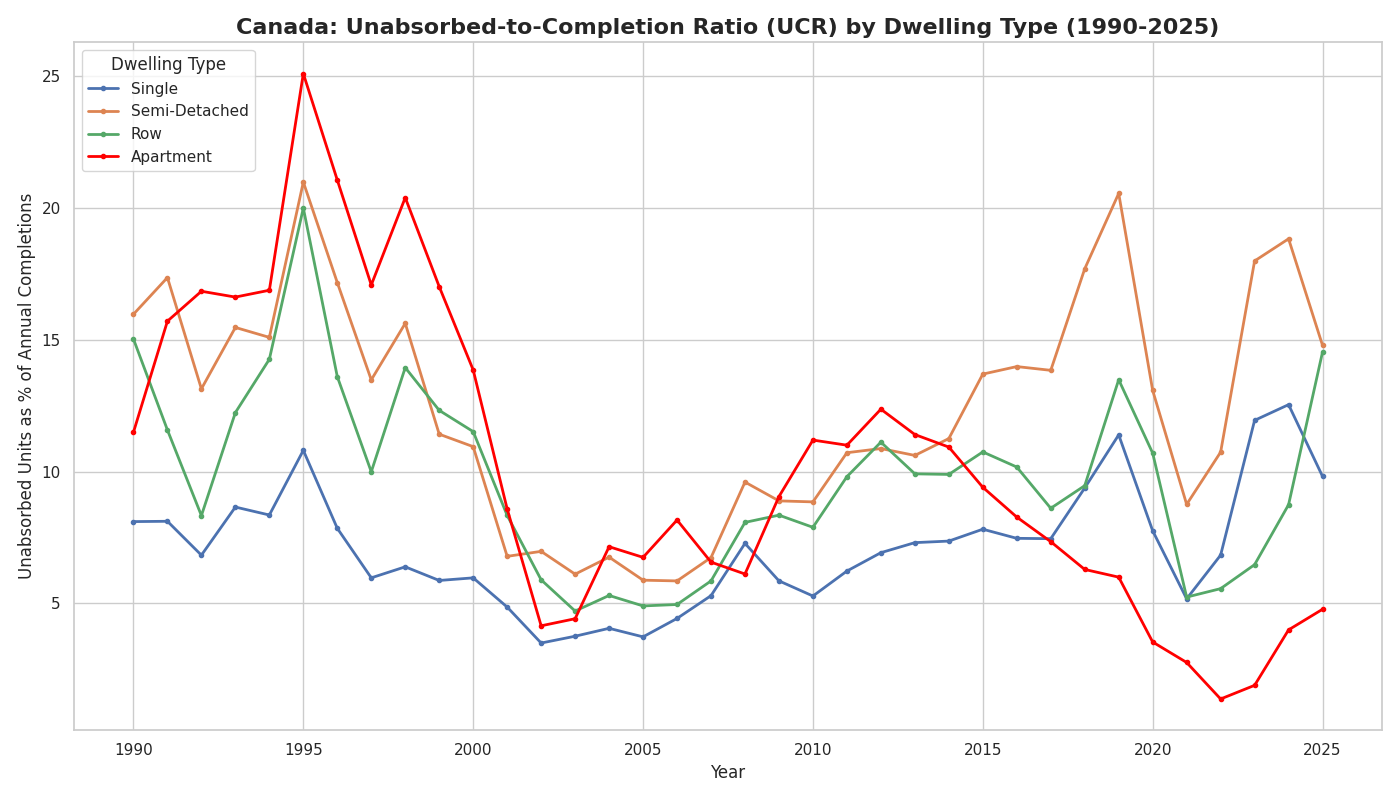
Combining unabsorbed inventory with completions by type, we can derive the unabsorbed inventory to completion ratio (UCR), which shows the percentage of homes in that housing type that are unsold relative to the amount constructed each year. This is one of the most critical statistics for understanding the current market demand for any given asset type:
Source:
Derived from
CMHC Housing Market Information Portal,
Calculated by Hawkeye Wealth
Asset types with a lower UCR mean there is higher demand for that asset, so it is easier to see that for everything other than apartments, there is a fairly high level of unabsorbed inventory compared to historical averages.
Now that we have a sound understanding of where demand in the market is at current levels of supply, we can begin the fun work of estimating where it is going based on inventories under construction and construction times.
The Construction Overhang
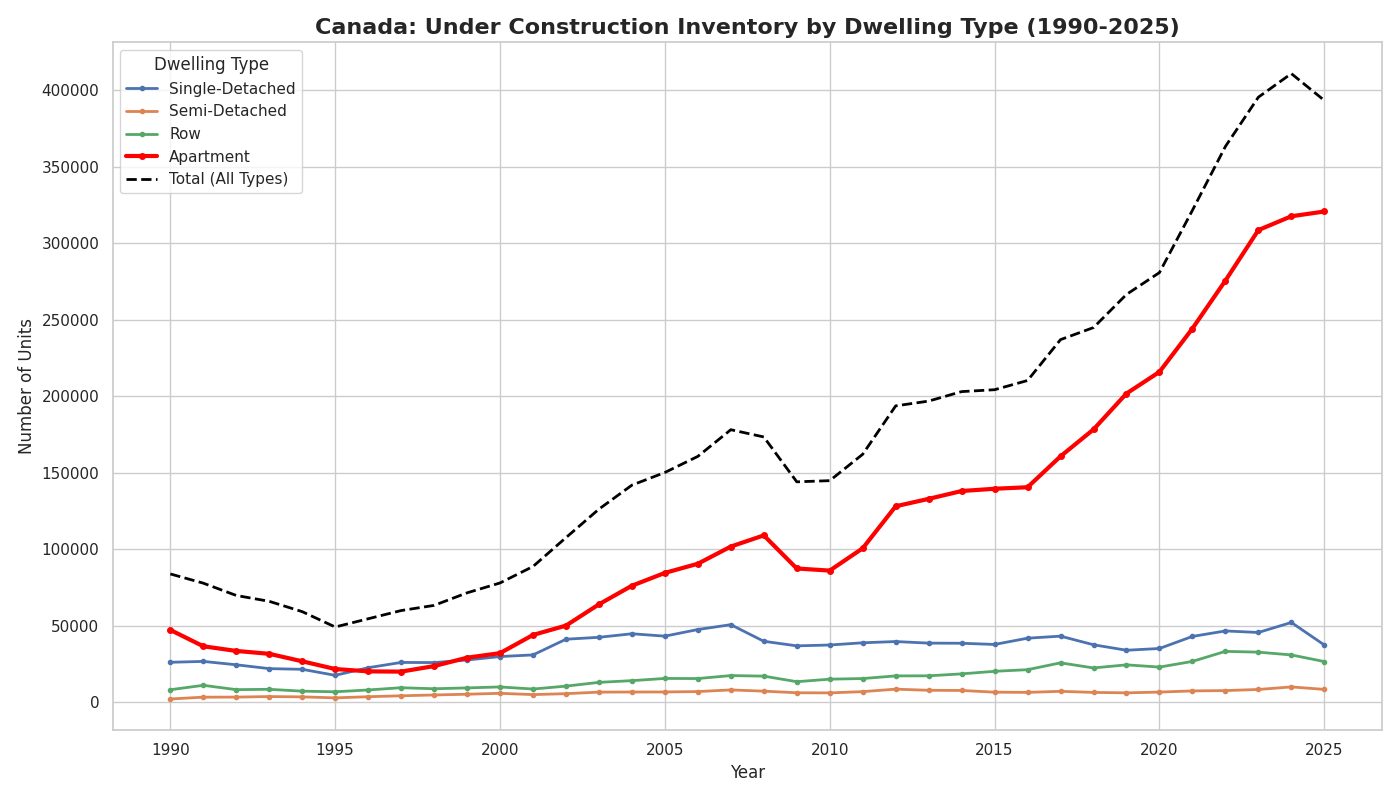
In Canada, the pace of housing starts has mostly been higher than the pace of completions since 1995. One of the chief effects of this incremental difference between starts and completions is that over time and by definition, inventory under construction has climbed to a level far higher than anything ever seen in the past:
Source:
Data from CMHC Housing Market Information Portal
There are two important structure notes to observe from this:
First, in Canada, when we talk about new housing, we are increasingly talking about apartments. The ~320,000 units under construction make up a whopping 81.5% of the total inventory under construction, so even small changes to absorption patterns in that market have disproportionately large effects.
While single-detached housing makes up only ~10% of the new home market, it is still the most common housing type overall, and these homes play a major role in price-setting for the resale market. When new single family homes go unsold and there is downward pressure on prices, that pressure also affects the resale market.
We only need one more piece of data before we can wrap it up to make predictions, and that is understanding how long it will take for these units under construction to be completed.
Construction times
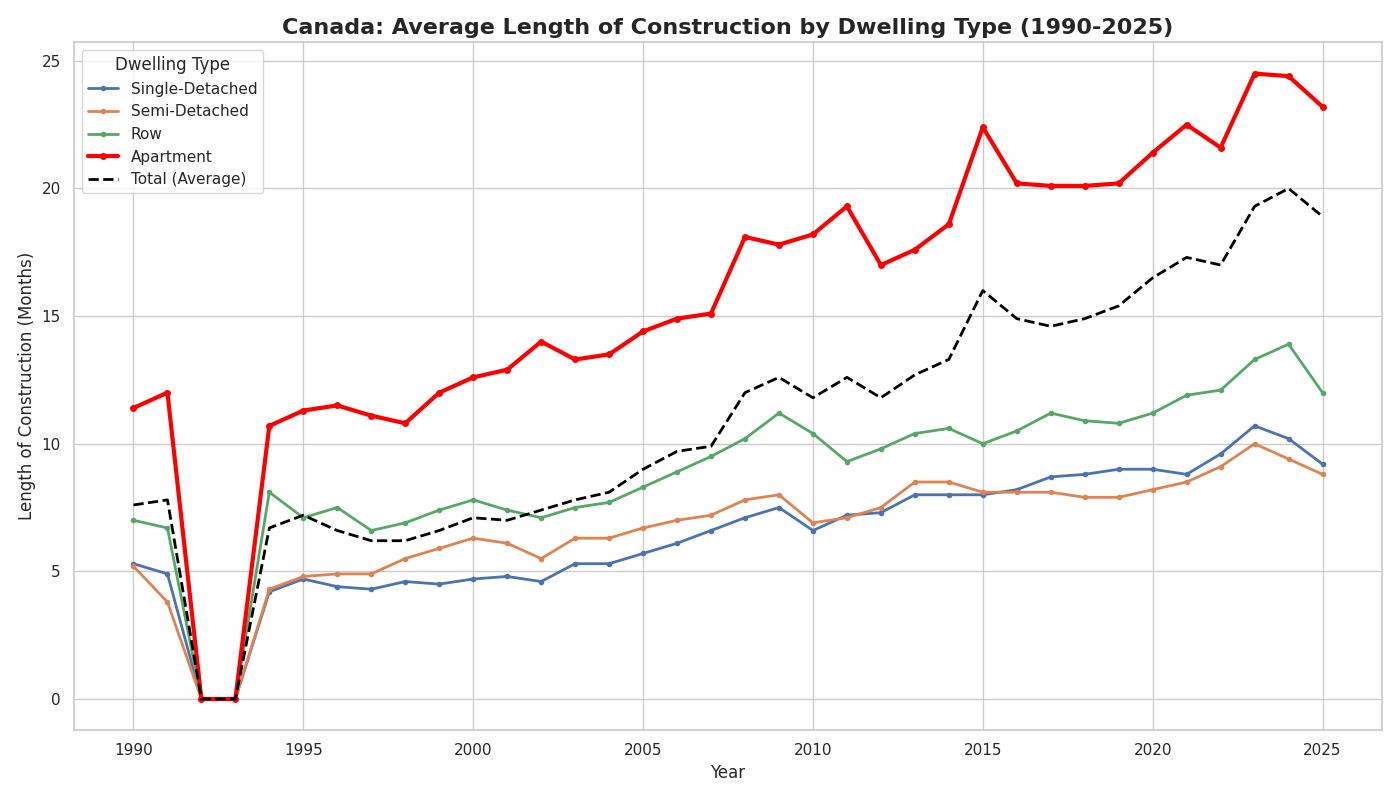
Ignoring the data blip of 1992-1993, construction times for every housing type have increased in a roughly linear fashion. There are many reasons for this that we will likely write about in the future, because we feel it is a material contributor to the overall housing affordability crisis, but for now, the most important data is the 2025 average construction time for each housing type:
Source:
Data from CMHC Housing Market Information Portal
Applying these averages to the inventory under construction for each type, we can create a short-term forecast for completions.
Putting all this data together
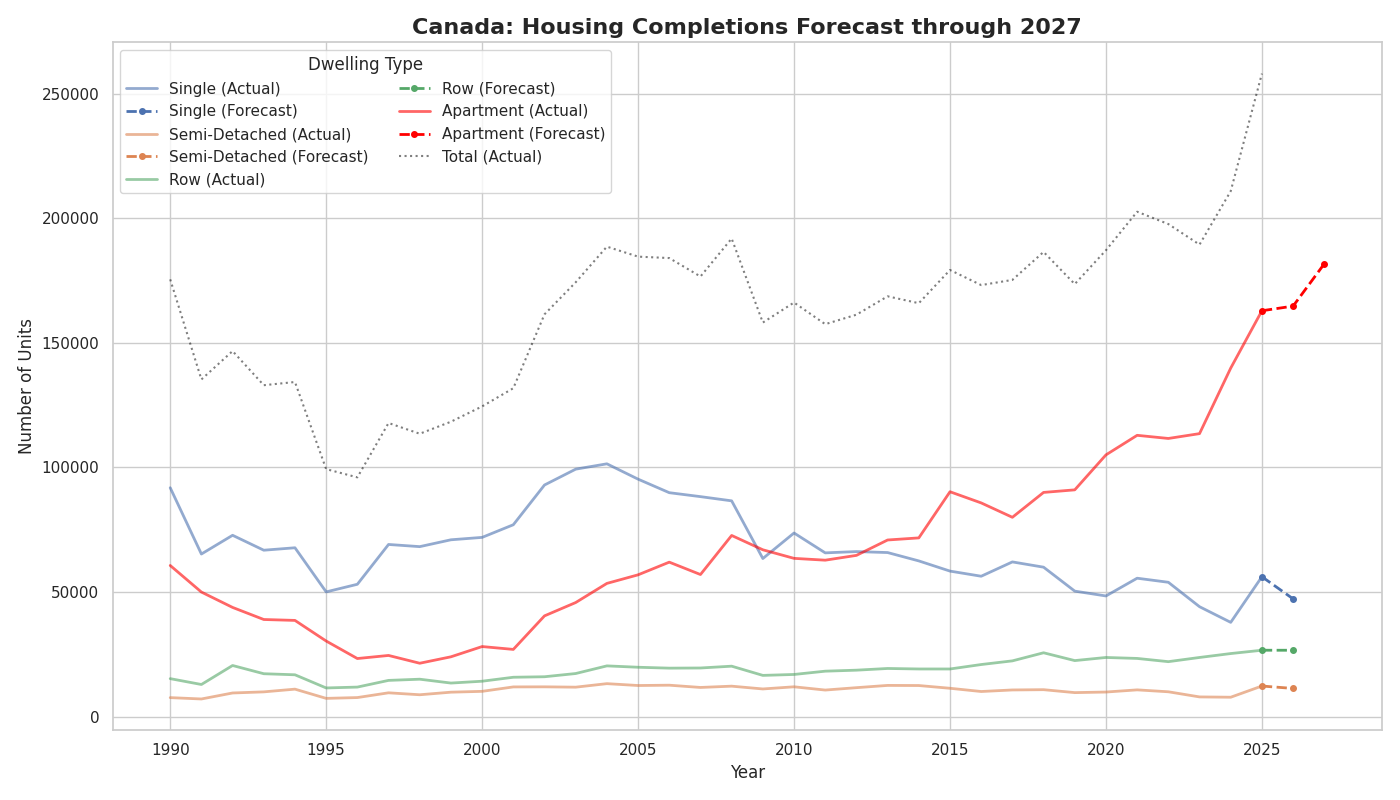
When you apply average construction times to inventory under completion, you get the following:
Source:
Data from CMHC Housing Market Information Portal,
Forecast from Hawkeye Wealth
For rigour, we referenced actual housing start data so that we could more accurately estimate when this inventory would come online.
The upshot is that we anticipate two years of even higher levels of apartment completion. For 2026, single-detached completions should fall with semi-detached completions also falling slightly. Row Housing will likely remain flat.
With current market absorption known and an estimate for future completions, we can finally get to the fun part, a picture of how far away each housing type is from reaching a bottom.
Unabsorbed Inventory Predictions
In short, we think that there will be slightly different ‘bottoms’ in Canada for each of the housing types:
1. Apartments - The market for completed apartment units has been the most resilient of all asset classes in Canada in recent years, but there are major caveats here. The pre-sale market, which is something of a canary in the coal mine, has been experiencing weakness for years.
The market has already demonstrated that it hasn’t been able to fully absorb the high number of completions from 2023-2025, and there are at least 2 more years of even higher completions coming. In our view, unless there is unexpectedly high demand growth, we are likely at least 2 years, and potentially 3-4 years from seeing a bottom as unabsorbed inventory will continue to grow and prices soften.
Verdict: A long way from the bottom
2. Row Houses
- Levels of unabsorbed inventory are comparatively high, and still rising. Row houses are expected to deliver a similar number of completions in 2026 as 2025, so we think that unabsorbed inventory will likely continue to grow and prices will soften. That said, the bottom here may only be 1-2 years off because a slowdown in building affects the market more quickly due to ~13 month construction times.
Verdict: Hasn’t bottomed, but is closer than apartments
3. Single-detached
- There isn’t strong demand for single-detached homes at current pricing, but 2026 projects lower completions than 2025, so there will be less pressure on unabsorbed inventory. When you combine this with the fact that the UCR (the unsold inventory relative to number of completions) peaked for single-detached homes in 2024, there are signs that barring further economic weakness, unabsorbed inventory is likely to flatten or even drop slightly and prices may hold.
Two cautionary notes on Single-detached data:
a)
There are high levels of regional variance in this category, so local research is particularly important.
b) While the market may be at or near the bottom, it is only because the building taps are being slowed, not because of improved demand, so it’s still highly vulnerable.
Verdict: Bottomed, and if it hasn’t, it’s close.
4. Semi-detached
- This is a hard category because it’s so small it can swing more wildly from year to year. Demand is low for semi-detached, but like single-detached, the category will see fewer completions in 2026 than it did in 2025. Also like single-detached, the UCR for semi-detached peaked in 2024.
Verdict: Bottomed, but with demand even more precarious than single-detached, it’s extremely vulnerable.
Conclusion
The combined factors of unabsorbed inventory, completions, inventory under construction and average construction time can provide an excellent indication of market health and positioning in a market cycle. When unabsorbed inventories are high and likely to rise, prices are likely to fall.
Until more robust demand returns and the economy strengthens, the housing market will remain in a precarious balance, but finding a market "bottom" will not be uniform for each asset type nor across geographies.
For high-density condo projects, the correction phase appears far from over. Conversely, single-family and semi-detached segments are showing signs of stabilization, even if that stabilization is driven by lower supply rather than stronger demand.