
Assessing Entitlement Risk For Investors
“Development required multiple steps, and every step meant one more chance for something to go wrong.”
- Sam Zell, Am I Being Too Subtle?
Development isn’t for the faint of heart, but it can be rewarding when navigated with precision. While market demand and building costs set the foundation for any project, entitlement risk remains one of the most volatile development variables. To an outsider, entitlement feels like a binary "yes or no" outcome, but in reality, it is a graduated staircase of legislative and administrative hurdles where risk is systematically removed at every milestone.
Since the passage of
Bill 44 on November 30, 2023, the entitlement risk profile in BC has shifted. While a massive development slowdown has temporarily masked the benefits, the impact is structural. Public hearings, a major component of entitlement risk, are now prohibited for residential projects that align with an Official Community Plan (OCP).
In this edition of the Bird’s Eye View, we examine the interaction between OCPs and Zoning Bylaws. We map out the legislative processes that a development goes through and the precise moments where entitlement risk ‘steps down’, information that a savvy investor can use to evaluate the risk and reward of a development deal at any stage of the process.
OCP and Zoning Bylaw
The interplay between an OCP and a Zoning Bylaw is a relationship of vision versus law. The OCP serves as a high-level, long-term strategic map that outlines the city’s future intent for land use, density, and community character in various areas of a City.
However, it is the Zoning Bylaw that provides the granular, legally binding rules for every specific parcel of land, including permitted uses, height limits, and setbacks.
For a development to proceed, s. 478 of the
Local Government Act
requires that its zoning must be consistent with the OCP. If a project aligns with the OCP’s vision but the underlying zoning does not yet allow for it, the Zoning Bylaw must be amended, though a public hearing is no longer required. If the project doesn’t align with the OCP however, it significantly increases the ‘height’ of the entitlement risk.
The Entitlement Staircase
When legislative hurdles are mapped onto a timeline, we see that the entitlement process is a series of discrete events where varying levels of risk come off the table at each step:
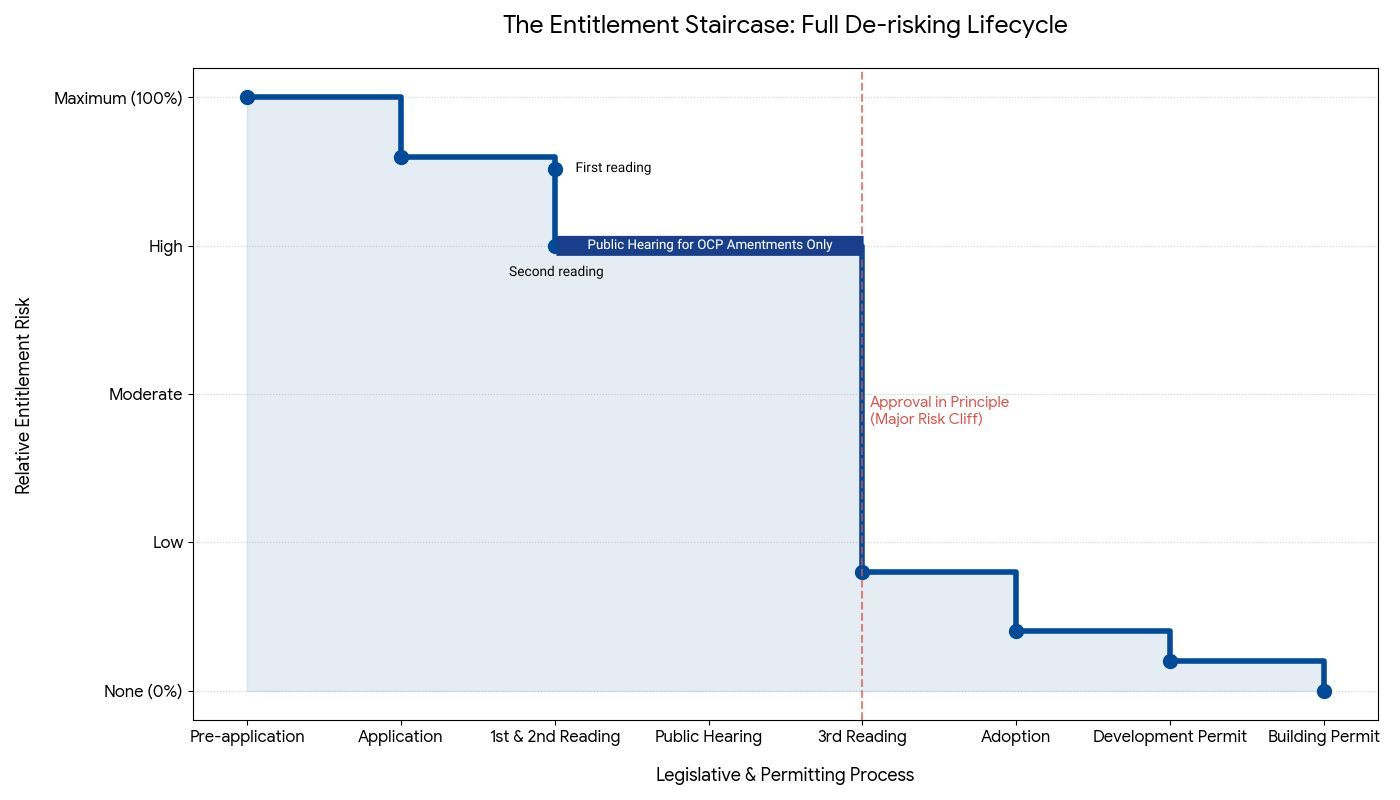
Source: Hawkeye Wealth
The following list explains what occurs at each milestone and the specific risk removed:
1. Pre-Application
What Happens: The developer meets with municipal planning staff for a pre-application review. This is an informal review to identify major red flags such as sewer or water capacity issues, heritage concerns, or blatant conflicts with the Official Community Plan
Risk Removed: The risk of a 'hard no' on the basic concept is eliminated.
2. Application
What Happens: The developer submits a formal package including preliminary architectural drawings, site surveys, and the required fees. The city assigns a file manager and starts the formal referral process to departments like Engineering, Fire, and Parks.
Risks Removed: The risk that the application is technically deficient or lacks necessary documentation is removed. Once an application is in, the project is also protected against adverse legislative changes or fee increases for a period of time.
3. First and Second Reading
What Happens: These votes usually occur during the same Council meeting. First reading is a procedural step to put the bylaw in front of Council for formal review, typically involving no substantive debate. Second reading is when Council begins debating the merits of the development after reviewing staff recommendations and developer presentations. Because Bill 44 now prohibits public hearings for OCP-compliant projects, second reading has become a more significant stage where Council is more inclined to request project changes.
Risk Removed: First reading removes that negligible risk that a staff-supported application will fail to enter the legislative queue. Second reading gives the developer their first formal view into the leanings of Council and provides a sense of whether the project is likely to be approved or what changes might be required. In the new legislative landscape, clearing second reading is a stronger indication of Council’s general satisfaction with the project’s scale and design without requiring further major concessions.
4. Public Hearing
What Happens: This is the primary forum for community input and occurs between second and third reading. Under Bill 44, this step is prohibited for residential projects that align with the OCP, but it remains mandatory for projects requiring an OCP amendment.
Risk Removed: In reality, public hearings usually skew towards negative submissions, though there is variance in the level of interest based on the location of the development. The question is always whether the level of neighborhood opposition displayed will successfully pressure Council to reject the project at third reading.
5. Third Reading
What Happens: Council votes on the project immediately following the public hearing or after second reading if no hearing is held. This is considered approval in principle.
Risk Removed: This is the most significant reduction in risk of the entitlement process. Once third reading is granted, the political will is established and the city is essentially committed to the project as long as the developer meets the remaining technical conditions.
6. Adoption (Final Reading)
What Happens: This occurs once the developer has satisfied all the conditions of third reading such as paying Development Cost Charges, signing legal covenants, or securing servicing agreements.
Risk Removed: The OCP or zoning bylaw is officially adopted and becomes law. The density and use are now vested in the land. Some would argue that this is the point where entitlement risk is zero, though in our view, that doesn’t come until permits are in hand.
7. Development Permit (DP)
What Happens: The focus shifts from use and density to form and character. The city reviews the specific design, materials, landscaping, and environmental impacts of the building.
Risk Removed: The risk that the city will demand significant architectural changes or redesigns that impact the project's layout or cost.
8. Building Permit (BP)
What Happens: This is a purely technical review of the detailed construction drawings to ensure they comply with the BC Building Code and safety standards.
Risk Removed: Protects against changes to building codes. This is the final 0 percent mark on the staircase. The developer now has the absolute legal right to commence construction.
Conclusion
The purpose in understanding these milestones isn’t to study in municipal bureaucracy, it’s a necessary component for evaluating the risk-adjusted returns of a development deal.
While the slow market has temporarily made the 2023 legislative amendment moot, the long-term structural shift of Bill 44 is undeniable, and we are eagerly watching to see how the removal of public hearings for most projects will affect future investment structures. In particular we are asking:
- Will the removal of public hearing volatility encourage investors to enter projects at the application stage rather than waiting for third reading?
- If the overall level of entitlement risk has been compressed for certain projects, will the risk-premium demanded by early-stage capital shrink?
- Will ‘eligible for OCP-compliant rezoning’ become the new gold standard for de-risked land acquisition?
We don’t know the answers definitively, but we do know that at some point the ‘tap’ of development will inevitably turn back on. When it does, the advantage will go to those who understand entitlement not as a game of chance, but as a sequence of de-risking milestones that may present attractive risk-adjusted investment opportunities.