August 22, 2026

When Will Rents Go Up Again?

“If you see a crane on a residential building site in your community, chances are it’s a project backed by CMHC”

— Coleen Volk, President and CEO, CMHC
2025 Annual Report


Introduction


It was a genuine treat to wake up on Tuesday and read RBC’s almost optimistic housing update entitled “Slowly but surely Canada’s housing market is turning around”.  Sure, it’s a little early to say the market is recovering, but you’ve got to start somewhere!

Setting aside the vast regional differences in housing price trends, we tend to agree with RBC that after what has been a brutal few years in the housing market, there are real reasons for investors to be more optimistic about the future.  Unfortunately, that optimism is born from the fact that new supply is drying up, and it's becoming increasingly likely that at some point, there will be a whiplash in prices.  The big question for investors is: when?

The answer to that question requires understanding the market behind the last holdout of the building boom, purpose-built rental.  In our view, this market may have just hit its high-water mark, and the supply tap will soon be turned down there too as it has been for every other housing type.

In this edition of the Bird’s Eye View, we discuss why new rental starts have persisted despite less appealing market conditions, and how recent and upcoming changes to CMHC programs will likely slow that pace.  For investors who own rental assets, having a rough sense of when rental supply will be absorbed in your area is critical for your investment planning.

Canada Builds Rentals

For the past 5 years, Canada has delivered more housing starts than at any other point in its history (StatCan), though on a per capita basis the building rate is roughly half of what it was in 1976.

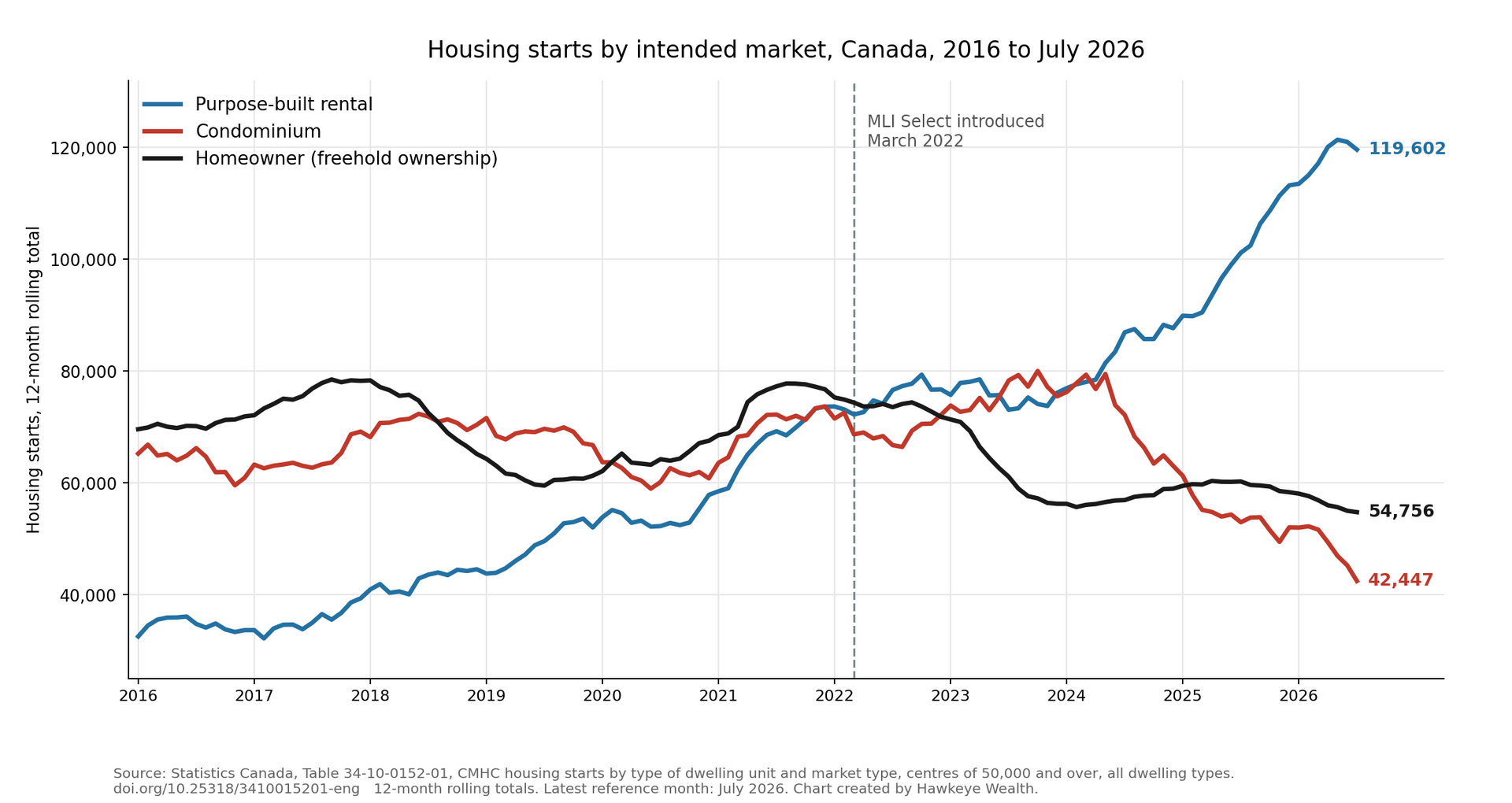
The graph below shows that the rise of purpose-built rental has been the primary driver behind those increased starts:

Graph comparing Canadian population growth and new home prices from 1982-2007. Includes projected growth rate.

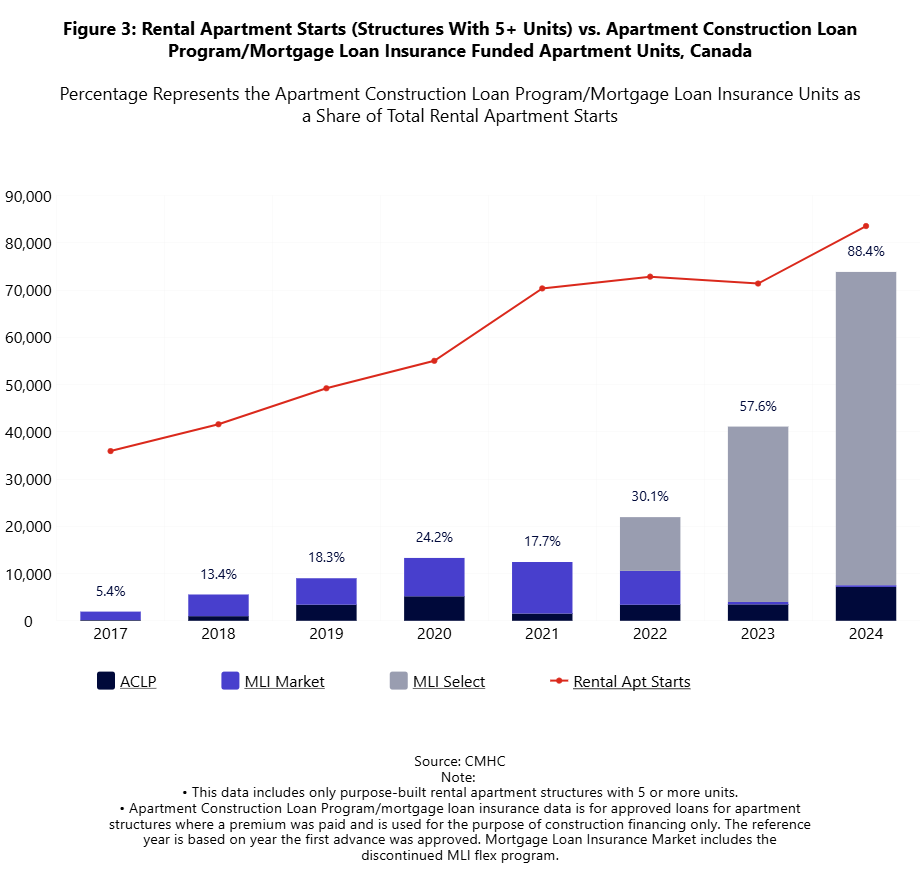
There have been a confluence of factors that have supported the growing popularity of purpose built rentals, including strong demand, favourable tax treatment, rent control exemptions in Ontario, and a soft condo market. But more than anything else, this increase has been driven by extremely inexpensive borrowing costs on CMHC-insured loans.  The chart below gives you a good sense of how huge CMHC's role has been in the rental building market, most especially after 2022 through the MLI Select program.

Table comparing provincial NPR figures in July 2021 and July 2004, including increase percentage and population share.

What is MLI Select?

MLI Select is low cost mortgage insurance.  The developer pays CMHC a one-time premium and in return, the federal government guarantees the mortgage, which gives lenders the freedom to lend far more, for far longer, at closer to government rates, because the lender no longer carries the risk.

MLI Select was so special because it allowed developers to borrow at 95% LTV (5% down), with 50 year amortization and limited recourse for a one-time insurance premium of as low as 1%, so long as you qualified for 100 points by ensuring the building meets a mix of affordability, energy efficiency or accessibility standards. Both new and existing buildings were eligible for this funding.

During the first two years, the program was structured so that it was possible to achieve the 100 point threshold through energy efficiency alone, with no affordable units (
Source). Over time though, the program has been diluted.

In June of 2023, premiums at the 100-point tier were hiked to 2.55%, and in 2024 the point system was revised so that affordable units were required in order to hit the top tier.

In
July of 2025, the flat fee structure was replaced with a risk based system.  Functionally, someone building at the 100-point tier with a 95% LTV, a 50-year amortization (the highest risk profile) would now be required to pay a ~5.8% premium.

Lastly, in November 2025, CMHC announced changes that,
effective September 30, 2026, will require higher energy efficiency thresholds in order to achieve energy efficiency points, on top of a stricter baseline, the 2020 NECB (National Energy Code) instead of the 2017 NECB (Source).  The upshot is that buildings need to be ~35-45% more energy efficient to achieve max points for energy efficiency.

Frankly, MLI Select is still a useful program, it’s just no longer so powerful that it makes sense for developers to build rental housing independent of what the market is doing.


What is the Rental Market Doing?


The short version is that it's softening.  Rental vacancy in Canada went from 2.2% in October 2024 to
3.1% by October 2025, and while we suspect that new starts may have crested in May 2026, completions are still a long way from their top.  There are still 218,056 rental units under construction, and most of them will land in 2027 and 2028.

On the population front, Canada’s non-permanent resident population is
down by almost 600,000 people from its October 2024 peak, and Canada’s overall population has fallen for three straight quarters.  While most forecasters expect this to stabilize and turn mildly positive in the next 2 years, it doesn’t change that it will take time to absorb peak supply into suppressed demand once units are completed.  It's only once that supply is mostly absorbed that we expect rents to rise substantially, and if there is limited supply afterwards, that rise could be violent.

When will rents go up?


When the market will clear is a matter of honest disagreement.  In our recent
Canadian Private Real Estate Podcast, Carl Gomez, Chief Economist at Centurion, shared his thinking that, “we’re close to the bottom of the rent growth cycle and we’re probably setting ourselves up going into 2027 for much more positive rent growth on average”. In contrast, CMHC forecasts that in 2028, vacancy rates will be higher than today in 16 of the 19 markets that it forecasts.

In our view, we think there is enough new supply coming online that rents may be flat-ish until late 2028 or early 2029.

Conclusion

Whomever is right timing wise, we are becoming increasingly confident about the setup.  Starts have been falling sharply in almost every category except rentals, and we think that if rentals haven’t crested, they are close.

If the taps truly are turning off across the board, when even tepid demand absorbs outstanding supply, we think the transition from oversupply to undersupply could happen quickly and stay around for years.  We don’t take too much joy because that period could be very hard for Canadians, but as investors, we can’t help but let ourselves get a little bit excited about what appears to potentially be the best real estate investment setup that Canada has seen since COVID.

Author

Hawkeye Wealth Ltd.

Date

August 22, 2026

Share

By Hawkeye Wealth Ltd. July 14, 2026
When will BC's promised development cost charge cuts actually hit? Using Ontario's rollout as a guide, we forecast the timeline for real fee relief.
By Hawkeye Wealth Ltd. May 30, 2026
“When it’s the same legal issues that we are dealing with here, I think that bodes well for our arguments, and the appeals that we are seeking in B.C.” - Niki Sharma, BC Attorney General (source) “Good News”. - David Robbins, lead counsel for the Cowichan Nation ( source )
By Hawkeye Wealth Ltd. April 9, 2026
“Rule No. 1: Most things will prove to be cyclical. Rule No. 2: Some of the greatest opportunities for gain and loss come when people forget Rule No. 1.”  — Howard Marks, Oaktree Capital