October 9, 2026

Inflation Hits Canadian Homeowners Harder Than Americans

“When the value of money falls… those persons who have engaged to pay fixed sums of money yearly must benefit… For example, the farmers throughout Europe, who had raised by mortgage the funds to purchase the land they farmed, now find themselves almost freed from the burden at the expense of the mortgagees.”


- John Maynard Keynes, A Tract on Monetary Reform, 1923


Introduction

When people call real estate an inflation hedge, they are usually thinking about the asset itself.  If labour, materials, land, municipal fees and construction financing become more expensive, a new building will cost more to deliver.  As long as there is sufficient demand, those costs are passed along to purchasers, and existing supply appreciates alongside new supply.

More than a century ago, Keynes described the second, less obvious part of the argument.  While inflation doesn’t reduce the amount owed on a mortgage, it does make those dollars easier to repay (as long as the mortgage is fixed) as the currency is devalued and incomes and rents rise over time.

The Canadian and US housing markets are structured differently enough that these effects of inflation don’t play out the same way across the border.

In this edition of the Bird’s Eye View, we look at how inflation affects both a property and its financing, why the inflation-hedge story doesn’t hold up quite as well in Canada as it does in the US, and why Canada’s calculation of the CPI further complicates the picture.

The Mechanics of Inflation

As always, let’s get the boring baseline info out of the way by reviewing the three main ways that inflation affects real estate:


  1. Replacement cost: When all of the inputs to development and building cost more, the replacement cost for existing buildings goes up. That will mean higher prices if people are willing and able to pay those increased prices, but if they aren’t, developers choose to stop building and supply dries up. Over time, this also puts upward pressure on prices as excess supply is absorbed.

  2. Interest rates: Usually, inflation leads to rates being raised, which makes mortgages and other real estate financing more expensive. This reduces purchasing power and places downward pressure on prices because transactions and renewals require new debt at higher rates.

  3. Debt erosion: For anyone holding a fixed mortgage, inflation reduces the real cost of a mortgage. Inflation, which generally comes with some degree of rising incomes and rents, can make the same mortgage easier to carry over time.


What inflation does to real estate is pretty simple, but there is still complexity in how these mechanics interact. Let’s compare these mechanics by considering Canada, where renewals are much more frequent, against the US.

Erode More Debt Please!

Real estate’s inflation hedge is explained in part by property, and in part by mortgages.  The property portions work similarly in both countries, but Canada’s mortgage system doesn’t provide nearly as much of a hedge as the American system does.

Debt erosion only works in a borrower’s favour as long as their rate stays fixed. When a mortgage renews, it is repriced at current rates, and Canadians renew their mortgages
much more often.

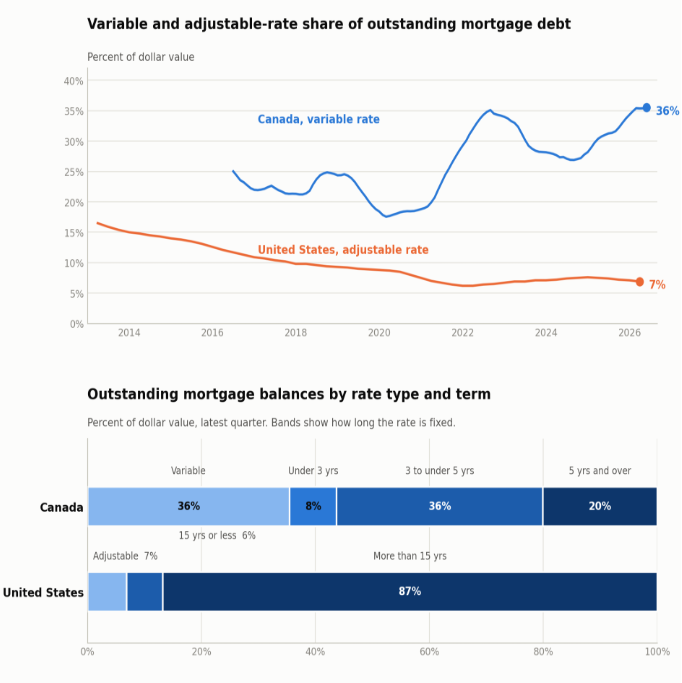
Consider the chart below:

Graph comparing Canadian population growth and new home prices from 1982-2007. Includes projected growth rate.

Source: Data from the Bank of Canada and the US Federal Housing Finance Agency's National Mortgage Database. Both series are weighted by dollar value, and the Canadian data covers chartered banks only. Term bands are set at origination, not remaining time to renewal.

In the US, more than 90% of residential mortgages are 30-year fixed contracts, and 87% of outstanding mortgage debt is fixed for more than 15 years. Only about 7% is on an adjustable rate, down from 16.5% in 2013. Once an American borrower locks in a rate, they get to keep it until the loan is paid off.  There are downsides to this structure (especially labour mobility because most mortgages can’t be ported), but most American borrowers stand to gain the full benefit of debt erosion that comes with inflation.


Canada’s situation is quite the opposite. Only 20% of Canadian mortgage debt is fixed for 5 years or more (down from 43% in 2016), and according to the CMHC, “only 11% of mortgages extended at chartered banks had the traditional fixed-rate mortgage with a 5-year term in February 2026”.

With so much emphasis on short term fixed-rate and variable mortgages, Canadian borrowers are much more exposed to the rate increases that come with inflation than their American counterparts.  Certainly, there are advantages to these mortgage structures, including lower rates and better terms, but inflation protection isn’t one of them.

The second major difference in inflation treatment between the US and Canada stems from how the CPI is calculated in both countries.

Mortgage Interest - In or Out?


Mortgage interest is inside Canada’s CPI, but the US removed it from its CPI in 1983.

This has become something of an issue in Canada.  If the common approach to inflation is to raise rates, but those rates circularly feed inflation because of higher mortgage interest costs, it makes it difficult for the Bank of Canada to hit its 2% inflation target.

In 2023, the Governor of the Bank of Canada, Tiff Macklem
acknowledged the effect on inflation:


"The single price increase that is having the biggest impact on CPI inflation is mortgage interest costs, which have gone up as we've increased interest rates. They're about 30% higher than they were a year ago. When you exclude mortgage interest costs, CPI inflation is close to 2 1/2%."


To be clear, this isn’t to say that raising interest rates is wrong, only that when we do so in Canada, the cure becomes a part of the problem. This effect is once again much more pronounced because of the proportion of variable and short term fixed-rate mortgages in Canada.  Interest rates hit inflation hard and fast.  Even though mortgage interest made up only about 3.5% of the CPI basket, it added close to a full percentage point to headline inflation through the second half of 2023.

Conclusion

Real estate does offer genuine protection against inflation, but part of that protection comes from the mortgage rather than the property. In Canada, our mortgage system doesn't offer the same level of inflation hedging as what exists in the US.


Keynes's farmers were freed from their debts because their mortgages stayed fixed while inflation did its work. Most American borrowers benefit from that same arrangement, while Canadian borrowers only get it for a few years before the mortgage is repriced. It's that same frequency of renewals that also makes the mortgage interest portion of the CPI calculation so pronounced.


None of that makes Canadian real estate a bad investment. It does, however, mean that investors need to account for inflation risk differently in Canada than they would in the US.

Author

Hawkeye Wealth Ltd.

Date

October 9, 2026

Share

By Hawkeye Wealth Ltd. • August 22, 2026
“If you see a crane on a residential building site in your community, chances are it’s a project backed by CMHC” — Coleen Volk, President and CEO, CMHC 2025 Annual Report
By Hawkeye Wealth Ltd. • July 14, 2026
When will BC's promised development cost charge cuts actually hit? Using Ontario's rollout as a guide, we forecast the timeline for real fee relief.
By Hawkeye Wealth Ltd. • May 30, 2026
“When it’s the same legal issues that we are dealing with here, I think that bodes well for our arguments, and the appeals that we are seeking in B.C.” - Niki Sharma, BC Attorney General (source) “Good News”. - David Robbins, lead counsel for the Cowichan Nation ( source )